
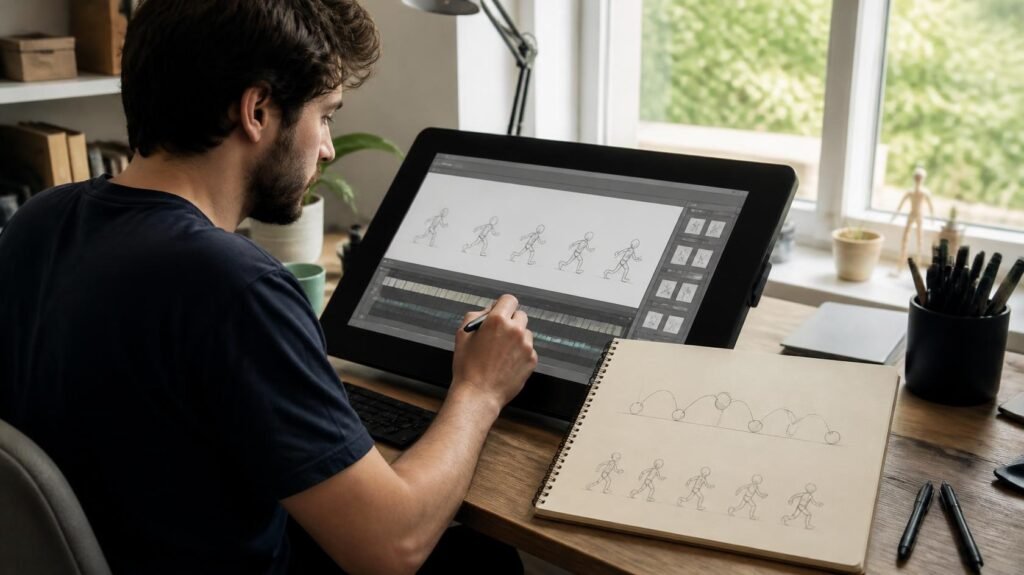
Learning 2D animation can seem overwhelming when you first see how much work goes into bringing a character to life. From drawing individual frames to creating smooth movements, the process involves several skills that take time to develop. Naturally, one of the first questions beginners ask is: How long does it take to learn 2D animation?
The short answer is that most beginners can learn basic 2D animation techniques within 1 to 3 months of consistent practice. Developing intermediate skills may take 6 to 12 months, while reaching a professional standard often requires one to three years or longer.
However, your progress depends on your learning approach, artistic background, chosen software, and the amount of time you dedicate to practising.
This guide explains realistic learning timelines, the essential skills you need, and how to build a practical learning plan without wasting months on unnecessary techniques.
How Long Does It Take to Learn 2D Animation?
There is no universal timeframe for mastering 2D animation. Someone learning simple motion graphics may progress faster than a beginner interested in traditional frame-by-frame character animation.
Your ultimate goal plays a major role in determining how long the learning process takes.
Here is a general breakdown of what you can expect.
| Skill Level | Estimated Learning Time | What You Can Achieve |
|---|---|---|
| Beginner | 1–3 months | Basic movements, bouncing balls, simple animated objects |
| Early Intermediate | 3–6 months | Walk cycles, basic character movements, short animations |
| Intermediate | 6–12 months | More convincing motion, character acting, simple storytelling |
| Advanced | 1–2 years | Complex sequences, refined timing, stronger character performances |
| Professional Development | 2–3+ years | Portfolio-quality work, specialised workflows, production experience |
These estimates assume regular, focused practice rather than occasional experimentation. They are planning guidelines, not guaranteed milestones.
Learning 2D Animation as a Complete Beginner
If you have never animated before, your first few weeks will usually involve understanding fundamental animation concepts.
You will learn how frames create the illusion of movement, how to control timing, and why objects accelerate or slow down.
For example, creating a bouncing ball might seem like a simple exercise. However, it teaches several essential techniques, including timing, spacing, squash and stretch, and the effect of gravity.
Once you understand these concepts, more complicated animations become easier to approach.
How Long Does It Take to Become Job-Ready?
Becoming employable as a 2D animator takes considerably longer than learning the software.
Employers and clients generally want evidence that you can produce convincing movement, solve animation problems, follow creative direction, and complete projects reliably.
A dedicated learner might develop a competitive entry-level portfolio within 12 to 24 months. Others may need considerably longer, especially when focusing on traditional character animation.
Your portfolio quality matters more than the number of months you have studied.
What Skills Do You Need to Learn 2D Animation?
Before choosing a course or purchasing software, it helps to understand what 2D animation actually involves.
The learning process combines artistic observation, movement principles, technical knowledge, and creative decision-making.
1. Understanding the 12 Principles of Animation
The 12 principles of animation provide the foundation for creating believable, expressive movement.
Some of the most important principles for beginners include:
- Squash and stretch: Makes objects and characters feel flexible and responsive.
- Timing and spacing: Controls the speed and rhythm of movement.
- Anticipation: Prepares viewers for an upcoming action.
- Slow in and slow out: Creates natural acceleration and deceleration.
- Follow-through: Makes movement feel less mechanical.
- Arcs: Helps create fluid, natural-looking motion.
These techniques apply to everything from a bouncing ball to a character jumping across a room.
Toon Boom’s official learning resources introduce these principles through practical exercises, including pendulum movement and bouncing-ball animation.
2. Drawing and Visual Observation
You do not need to be an exceptional artist before starting 2D animation.
However, drawing skills become increasingly valuable when creating original characters, expressive poses, and traditional frame-by-frame sequences.
Focus on learning basic shapes, proportions, perspective, and gesture drawing.
More importantly, practise observing movement.
Watch how people walk, how animals change direction, and how objects react when they fall. Understanding these movements helps you create animations that feel believable.
For rig-based animation or simple motion graphics, advanced drawing skills may be less important than timing and composition.
3. Learning Animation Software
Choosing appropriate software can significantly affect your learning experience.
Beginners often spend too much time comparing applications instead of developing animation skills.
Popular options include:
| Software | Suitable For |
|---|---|
| Krita | Beginners exploring hand-drawn frame-by-frame animation |
| OpenToonz | Traditional-style digital animation |
| Pencil2D | Simple frame-by-frame animation exercises |
| Adobe Animate | Vector-based animation and interactive content |
| Toon Boom Harmony | Character animation and professional production workflows |
| Blender Grease Pencil | 2D animation with 3D scene integration |
You do not need to master multiple applications immediately.
Choose one program that suits your intended animation style and learn its timeline, layers, keyframes, drawing tools, and export settings.
What Factors Affect How Quickly You Learn 2D Animation?
Two beginners following the same tutorial may progress at very different speeds.
The difference often comes down to their previous experience, practice habits, and learning goals.
Your Previous Drawing Experience
Someone familiar with anatomy, perspective, and digital illustration may find character animation easier to learn.
They can spend more time understanding movement instead of struggling with basic drawing techniques.
However, strong illustration skills do not automatically translate into strong animation skills.
An excellent drawing can still produce an unconvincing animation if the timing and spacing are incorrect.
How Many Hours You Practise
Consistency matters more than occasional marathon study sessions.
A learner practising five days per week will generally have more opportunities to build and retain skills than someone who only animates occasionally.
Consider this illustrative weekly schedule:
| Daily Practice | Weekly Practice (5 Days) | Learning Approach |
|---|---|---|
| 30 minutes | 2.5 hours | Gradual learning alongside other commitments |
| 1 hour | 5 hours | Consistent beginner skill development |
| 2 hours | 10 hours | More intensive practice and project work |
| 4 hours | 20 hours | Structured, high-commitment learning |
More hours can provide additional learning opportunities, but only when practice is purposeful.
Repeatedly creating the same animation without identifying weaknesses will not necessarily produce meaningful improvement.
The Type of Animation You Want to Create
Not every form of 2D animation requires the same technical abilities.
For example, animating text and basic shapes for a social media advertisement can be easier to learn than producing a hand-drawn character performance.
Rig-based animation also differs from traditional frame-by-frame animation.
With rigging, you create or assemble a character from reusable parts and control its movement through a digital structure.
Traditional frame-by-frame animation requires drawing successive poses and transitions.
Neither approach eliminates the need to understand movement, but they involve different workflows and learning curves.
Quality of Feedback
Feedback is one of the most overlooked parts of learning animation.
Beginners frequently recognise that an animation looks unnatural without understanding why.
An experienced animator might identify problems with overlapping action, inconsistent spacing, or weak silhouettes.
Receiving specific feedback allows you to correct these issues rather than repeatedly making the same mistakes.
How to Learn 2D Animation Step by Step
A structured learning roadmap can help you avoid the common mistake of attempting complicated character animations before understanding basic movement.
The following six-month plan is designed for beginners who can practise approximately one to two hours per day, five days per week.
Month 1: Learn the Fundamentals
Start by understanding how animation works.
Learn about frames, key poses, timing, spacing, and squash and stretch.
Practise simple exercises such as bouncing balls, swinging pendulums, and moving objects.
Goal: Produce several short animations with controlled movement.
Month 2: Practise Basic Character Movement
Once you understand basic motion, begin animating simple characters.
Start with stick figures before moving towards more detailed designs.
Practise walk cycles, jumps, and changes in direction.
Goal: Create a readable walk cycle and a short action sequence.
Month 3: Develop Character Expression
Character animation requires more than realistic body movement.
Learn how facial expressions, posture, and gestures communicate emotions.
Experiment with head turns, blinking, smiling, and surprised reactions.
Goal: Animate a character expressing at least three different emotions.
Month 4: Learn Basic Storytelling
Animation becomes more engaging when movement communicates a clear idea.
Learn about storyboarding, shot composition, scene transitions, and character interactions.
Start with a simple story involving one or two characters.
Goal: Develop a short animated scene with a clear beginning, middle, and end.
Month 5: Improve Animation Quality
Return to your earlier projects and examine their weaknesses.
Focus on refining key poses, correcting timing, cleaning rough drawings, and adding secondary motion.
Pay particular attention to whether the movement communicates the intended action.
Goal: Produce a more polished animation with consistent movement and visual design.
Month 6: Complete a Portfolio Project
Use everything you have learned to create an original animation.
Choose a manageable concept instead of attempting an overly complicated film.
A 15–30-second animation with simple characters and a limited number of shots can be an effective beginner project.
Goal: Complete one original project that demonstrates your strongest skills.
This roadmap is flexible. If you need additional time to understand walk cycles or character expressions, repeat those exercises before progressing.
Finishing a project well is more valuable than rushing through an ambitious animation that remains incomplete.
How Can You Learn 2D Animation Faster?
Learning efficiently does not mean skipping fundamentals. It means focusing on activities that produce measurable improvement.
Start With Small Animation Exercises
A common beginner mistake is attempting to create a five-minute animated film immediately.
Even a short film can require substantial planning, illustration, sound editing, animation, and revision.
Instead, begin with projects lasting three to ten seconds.
A bouncing ball, blinking character, or simple reaction animation provides an opportunity to practise important skills without becoming overwhelmed.
Use Reference Videos
Professional animators frequently study real-world movement to understand how actions unfold.
Record yourself walking, jumping, picking up an object, or turning your head.
Review the footage and identify the most important poses.
Then recreate the movement using simplified drawings.
The goal is not necessarily to copy every frame. It is to understand how weight, balance, acceleration, and timing influence the action.
Follow Structured Tutorials
Random tutorials can introduce useful techniques, but they do not always follow a logical learning sequence.
A structured course helps you understand which skills should come first.
For example, Toon Boom offers beginner learning modules covering animation principles, workflows, software fundamentals, and practical exercises.
Choose a learning resource that includes assignments rather than relying entirely on passive video demonstrations.
Revisit and Improve Previous Work
Save your early animations instead of deleting them.
After several weeks, recreate an earlier project using your improved understanding of movement.
Compare both versions and examine differences in timing, spacing, and readability.
This approach makes progress easier to evaluate and helps identify areas that still need attention.
Can You Learn 2D Animation Without a Degree?
Yes, you can learn 2D animation without obtaining a university degree.
Many essential skills can be developed through independent practice, online courses, mentorship, and portfolio projects.
However, learning independently requires discipline.
Without a structured curriculum, beginners may avoid difficult exercises, overlook weaknesses, or spend excessive time experimenting with tools.
A formal programme can provide organised training, collaboration opportunities, and regular feedback. Self-directed education offers greater flexibility and can reduce costs.
Neither route guarantees employment.
What Should a Beginner Animation Portfolio Include?
If your goal is freelance work or employment, begin developing a portfolio once you can produce reasonably controlled animations.
A beginner portfolio might include:
- A bouncing-ball exercise demonstrating weight and timing.
- A walk or run cycle showing body mechanics.
- A character reaction with clear emotion.
- A short interaction between characters.
- A polished original animation combining several techniques.
Focus on a small collection of strong projects rather than including every exercise you have completed.
Whenever possible, show your strongest work first.
For job applications, tailor the portfolio to the role. A studio hiring character animators may value expressive acting and body mechanics, while a motion graphics employer may prioritise typography, composition, and design.
Frequently Asked Questions About Learning 2D Animation
Is 2D animation hard to learn?
2D animation can be challenging because it requires an understanding of timing, movement, observation, and visual storytelling. However, beginners can learn the fundamentals through simple exercises and consistent practice. You do not need advanced drawing skills to begin.
Can I learn 2D animation in 30 days?
Yes, you can learn basic 2D animation techniques in 30 days if you practise regularly. You may be able to create bouncing balls, basic walk cycles, and simple moving objects. However, 30 days is generally insufficient to develop advanced character animation or professional production skills.
How many hours a day should I practise 2D animation?
One to two hours of focused daily practice is a reasonable starting point for many beginners. Short, consistent sessions allow you to develop skills while reviewing mistakes. The quality of your exercises matters more than simply accumulating hours.
Do I need to know how to draw to learn 2D animation?
No, advanced drawing skills are not required to start learning 2D animation. You can begin with basic shapes, stick figures, and rig-based characters. However, improving your drawing and observation skills can help significantly if you want to specialise in hand-drawn character animation.
Can I become a professional 2D animator in one year?
It is possible for some dedicated learners to develop a strong entry-level portfolio within one year, particularly if they already have relevant artistic skills. However, becoming professionally competitive depends on animation quality, specialisation, feedback, and industry requirements rather than a fixed timeframe.
Conclusion: How Much Time Should You Expect to Spend Learning 2D Animation?
Understanding how long it takes to learn 2D animation helps you establish realistic expectations and choose a learning approach that suits your goals.
Most beginners can develop foundational skills within one to three months, while more complex character animation and professional-level work typically require substantially longer.
The most effective approach is to learn animation principles, practise regularly, study real movement, and complete increasingly challenging projects.
You do not need expensive equipment or years of drawing experience to begin.
Start with one simple bouncing-ball animation, refine its timing and spacing, and build your skills from there. Once you understand the fundamentals, explore a beginner animation software guide and choose the tools that support your long-term creative goals.