
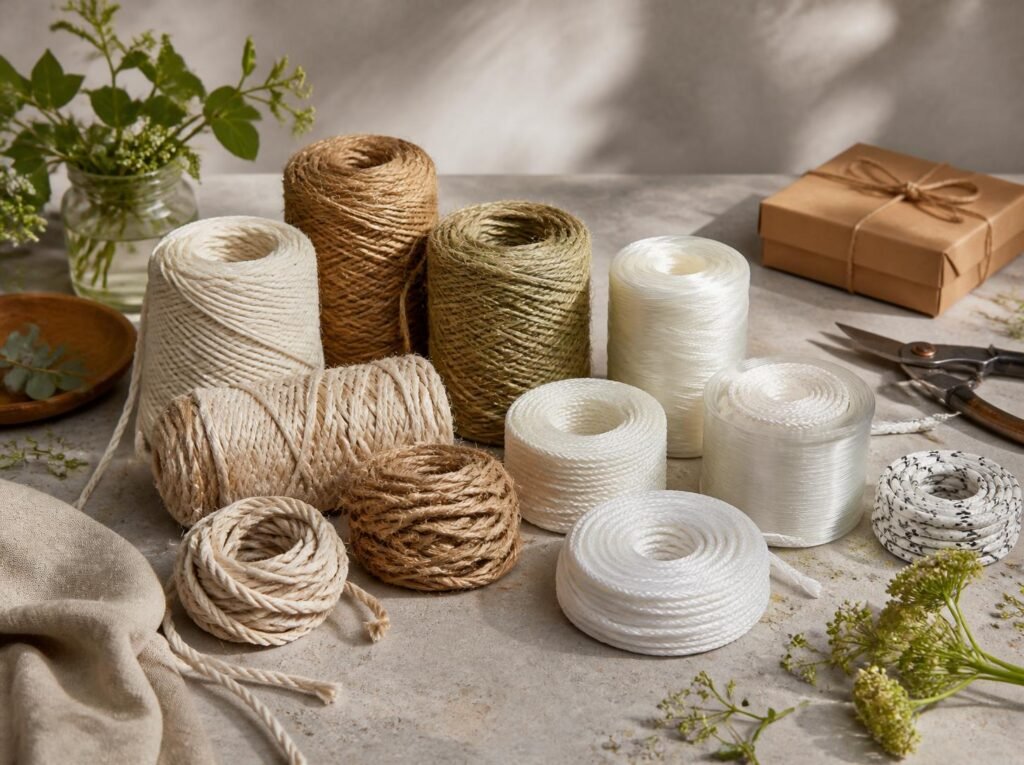
String may look like a simple everyday material, but choosing the wrong type can make a surprising difference. A string that works perfectly for gift wrapping might break during gardening, while one designed for outdoor use may be too stiff for delicate craft projects.
From cotton twine and jute to nylon, polyester, and specialized industrial fibers, different types of string offer distinct advantages in strength, flexibility, durability, and appearance.
Understanding these differences helps you choose materials that perform reliably without spending more than necessary.
This comprehensive guide explores the most common string materials, their properties, practical applications, and important factors to consider when selecting the right option for your needs.
What Is String, and Why Are There Different Types?
String is a thin, flexible length of material made from natural fibers, synthetic fibers, or other specialized substances. It is commonly produced by twisting, braiding, or combining individual strands to create a continuous length.
Strings serve numerous purposes, including tying, fastening, packaging, crafting, decorating, and supporting lightweight objects.
The main differences between string types involve their material composition, manufacturing process, thickness, and intended application.
Most strings fall into two broad categories:
Natural strings: Made from plant-based or animal-derived fibers, including cotton, jute, hemp, and sisal.
Synthetic strings: Manufactured from materials such as nylon, polyester, and polypropylene.
Neither category is universally better. Natural fibers are often preferred for their traditional appearance and renewable origins, while synthetic alternatives are frequently chosen for moisture resistance, durability, and consistent performance.
The best choice depends on how and where the string will be used.
Different Types of String and Their Common Uses
Understanding the characteristics of individual materials makes it easier to identify the most suitable string for a particular task.
1. Cotton String
Cotton string is one of the most widely used natural options because of its softness, flexibility, and versatility.
Manufactured from cotton fibers, it typically has a smooth texture and is available in various thicknesses, colors, and constructions.
Cotton string is commonly used for:
- Gift wrapping and decorative packaging
- Macramé and handmade crafts
- Sewing and textile projects
- Household organization
- Decorative hanging arrangements
One significant advantage of cotton is its comfortable handling. It can be tied into knots easily and generally works well for projects requiring frequent adjustments.
However, cotton absorbs moisture and may deteriorate when exposed to prolonged damp conditions.
Best for: Indoor crafts, decorative projects, and general household applications.
2. Jute String
Jute string is a natural plant-fiber material recognized for its rustic appearance and relatively coarse texture.
Its earthy brown color makes it particularly popular for decorative packaging, gardening, and handmade products.
Common applications include tying plant stems, creating rustic decorations, bundling lightweight materials, and wrapping gifts.
Jute is derived from a renewable plant resource, making it attractive to people seeking alternatives to conventional plastic-based string.
Nevertheless, jute can shed fibers, become weaker when repeatedly exposed to moisture, and deteriorate during prolonged outdoor use.
Best for: Rustic decorations, light gardening tasks, and environmentally conscious packaging.
3. Nylon String
Nylon string is a synthetic material valued for its strength, flexibility, and resistance to abrasion.
Unlike many natural fibers, nylon absorbs relatively little water and generally performs well in environments where occasional moisture exposure is unavoidable.
Its elasticity also allows it to stretch under tension, making it useful when some flexibility is desirable.
Typical applications include:
- Fishing lines
- Outdoor equipment
- Craft projects requiring durability
- Utility cord applications
- Certain sporting goods
However, nylon’s tendency to stretch can be a disadvantage when maintaining a fixed length is essential.
It can also deteriorate after extended ultraviolet exposure unless specifically stabilized for outdoor conditions.
Best for: Applications requiring a strong, flexible string with good abrasion resistance.
4. Polyester String
Polyester string is another widely used synthetic option known for its dimensional stability, durability, and relatively low stretch.
Compared with nylon, polyester generally maintains its length more consistently under tension.
It also offers good resistance to moisture and sunlight, making suitable grades useful for outdoor applications.
Polyester string is commonly found in camping accessories, outdoor decorations, sewing products, utility cords, and various industrial applications.
Its ability to maintain shape and resist environmental wear makes it practical for projects requiring consistent performance.
Best for: Outdoor applications, durable craft projects, and situations where limited stretching is important.
5. Hemp String
Hemp string is manufactured from fibers obtained from the hemp plant.
It is known for its natural appearance, relatively high tensile strength, and traditional use in ropes, textiles, and craft materials.
Hemp string is popular for jewelry making, decorative packaging, gardening, and handmade accessories.
The fibers are generally more textured than cotton, creating a distinctive appearance that works particularly well in rustic designs.
Although hemp can be durable, untreated natural-fiber string remains vulnerable to moisture-related deterioration.
Best for: Jewelry, decorative crafts, natural-fiber products, and lightweight tying applications.
6. Sisal String
Sisal string is made from fibers extracted from the leaves of the sisal plant.
Its coarse texture and relatively stiff structure distinguish it from softer materials such as cotton.
Sisal is traditionally used in agricultural applications, including tying plants, bundling materials, and manufacturing twine and rope.
It is also used in scratching products for cats because its textured surface provides resistance during scratching.
However, sisal can be uncomfortable for delicate handcrafting and may become brittle as it ages or experiences repeated environmental exposure.
Best for: Agricultural tying, rustic household products, and applications requiring a firm natural fiber.
7. Polypropylene String
Polypropylene string is a lightweight synthetic material frequently used in packaging, agriculture, and general-purpose utility applications.
It is valued for its low water absorption, chemical resistance, and affordability.
One notable characteristic is that polypropylene is less dense than water, allowing many polypropylene cords to float.
Common uses include packaging twine, lightweight outdoor tying, agricultural bundling, and general utility work.
However, ordinary polypropylene can degrade under prolonged sunlight exposure unless UV-stabilized.
Best for: Packaging, lightweight utility tasks, and moisture-exposed environments where floating capability may be useful.
8. Specialty High-Strength String
Some applications require materials that provide greater strength or resistance to challenging conditions.
Specialty strings may incorporate high-performance fibers such as aramid or ultra-high-molecular-weight polyethylene (UHMWPE).
These materials can offer impressive strength relative to their weight, although their performance depends heavily on fiber construction and manufacturing quality.
They are used in specialized sporting equipment, technical cordage, and certain industrial products.
Such materials are usually more expensive than standard household string.
Best for: Specialized applications with clearly defined performance requirements.
Natural vs. Synthetic String: What Is the Difference?
One of the most important decisions when selecting string is choosing between natural and synthetic fibers.
Both categories have advantages, but their properties can vary significantly.
| Feature | Natural String | Synthetic String |
|---|---|---|
| Common materials | Cotton, jute, hemp, sisal | Nylon, polyester, polypropylene |
| Texture | Often soft, rough, or fibrous | Often smoother and more uniform |
| Water resistance | Generally absorbs more moisture | Generally absorbs less moisture |
| Stretch | Depends on fiber and construction | Varies widely by polymer |
| Outdoor durability | Often limited without treatment | Often better with suitable grades |
| Appearance | Traditional, rustic, organic | Uniform, modern, versatile |
| Environmental considerations | Often renewable and potentially biodegradable | Usually petroleum-based and persistent |
Natural strings are particularly suitable for decorative applications where appearance and texture matter.
Synthetic strings are often preferable when consistent mechanical properties, moisture resistance, or outdoor durability are important.
However, material alone does not determine environmental impact. Manufacturing methods, chemical treatments, durability, and disposal options must also be considered.
For example, a natural string treated with synthetic coatings may not biodegrade as expected, while a durable synthetic string may provide a longer useful service life.
Types of String Based on Construction
String can also be classified according to how its individual fibers or filaments are assembled.
Understanding construction is useful because two strings made from the same material can behave differently.
Twisted String
Twisted string is manufactured by rotating individual fibers or strands together.
This construction is commonly found in cotton twine, jute, and traditional utility strings.
It is generally flexible, economical, and easy to handle.
However, twisted string may untwist or fray when its ends are not properly secured.
Braided String
Braided string is produced by interlacing multiple strands into a structured pattern.
This construction often provides a rounded, stable shape and improved handling characteristics.
Braided strings are widely used in decorative crafts, utility cords, and specialized technical applications.
Their strength depends on the underlying fiber, braid pattern, diameter, and manufacturing quality.
Monofilament String
Monofilament string consists of a single continuous filament rather than multiple twisted or braided strands.
Nylon fishing line is a familiar example.
Monofilament typically provides a smooth surface and relatively consistent diameter.
However, it may be less convenient to knot securely than softer multifilament constructions, depending on the material and intended use.
Multifilament String
Multifilament string contains numerous thin filaments combined into a single structure.
It can offer flexibility and a softer feel compared with certain monofilament products.
Such constructions are used in technical textiles, sporting equipment, and specialized cords.
The appropriate construction depends on the desired combination of flexibility, strength, handling, and durability.
How to Choose the Right Type of String
Selecting the right string requires more than comparing its appearance or price.
Several practical factors determine whether a material will perform reliably.
Consider the Intended Application
Start by identifying exactly what the string needs to accomplish.
Cotton is often suitable for decorative crafts, while polyester may be more appropriate for outdoor tying.
For gardening, jute or sisal can provide a natural appearance, particularly for temporary support.
For specialized equipment, choose materials specifically rated for the intended purpose.
Check Strength and Thickness
String thickness influences its handling and potential strength, but thicker string is not automatically stronger.
Material quality, construction, knots, and manufacturing standards also affect performance.
When strength matters, look for manufacturer-provided specifications rather than relying on appearance.
For any safety-critical application, use certified equipment with an appropriate working load limit. Ordinary craft string should never be substituted for climbing, lifting, or load-bearing safety equipment.
Evaluate Environmental Conditions
Consider whether the string will be exposed to sunlight, moisture, chemicals, or temperature changes.
Natural fibers can deteriorate during prolonged damp exposure.
Synthetic materials usually resist moisture more effectively, but their sunlight and heat resistance vary.
For long-term outdoor applications, choose products specifically designed and tested for those conditions.
Consider Flexibility and Knot Security
Soft, flexible strings are generally easier to manipulate during crafting and packaging.
Stiffer or smoother materials may behave differently when tied.
If secure knots are essential, select a string compatible with the appropriate knot type and test its holding performance.
Compare Cost and Longevity
The cheapest string is not always the most economical choice.
For temporary decorations, affordable cotton or jute may be entirely sufficient.
For repeated outdoor use, a more durable synthetic material may reduce replacement frequency.
Choosing based on actual requirements helps avoid unnecessary spending.
Common Mistakes to Avoid When Buying String
Even simple purchasing decisions can lead to disappointing results when essential details are overlooked.
A common mistake is assuming all strings with similar thickness have comparable strength. In reality, fiber composition and construction can produce substantial performance differences.
Another mistake is using untreated natural string outdoors for extended periods without considering moisture and weather exposure.
Buyers also sometimes confuse string, twine, cord, and rope. Although these terms overlap, products may differ in diameter, construction, intended application, and rated performance.
Finally, avoid assuming that every natural string is automatically biodegradable or environmentally harmless.
Dyes, coatings, additives, and manufacturing treatments can affect how a product behaves after disposal.
Reading product specifications carefully is often the simplest way to prevent these problems.
Frequently Asked Questions About Different Types of String
What are the most common types of string?
The most common types include cotton, jute, nylon, polyester, hemp, sisal, and polypropylene. Each material has different properties that make it suitable for particular household, craft, gardening, or utility applications.
Which type of string is the strongest?
High-performance synthetic fibers such as aramid and UHMWPE can provide exceptional tensile strength relative to their weight. However, actual string strength depends on its diameter, construction, manufacturing quality, and condition.
What is the best string for outdoor use?
UV-resistant polyester string is often a practical choice for outdoor applications because of its relatively low stretch, moisture resistance, and durability. However, the product should be specifically rated for the expected environmental conditions.
What type of string is best for crafts?
Cotton string is an excellent general-purpose option for many crafts because it is soft, flexible, and easy to manipulate. Jute and hemp are popular alternatives for projects requiring a rustic or natural appearance.
Is natural string better than synthetic string?
Neither is inherently better for every application. Natural string is often preferred for its appearance and renewable fiber sources, while synthetic string can offer improved moisture resistance and longer service life. The ideal choice depends on the intended use and environmental conditions.
Conclusion
Understanding the different types of string makes everyday projects easier, safer, and more cost-effective.
Cotton, jute, hemp, and sisal are useful for many traditional crafts and decorative applications, while nylon, polyester, and polypropylene offer properties suited to a range of practical and outdoor tasks.
The key is to evaluate material, construction, thickness, strength, and environmental exposure before making a selection.
Whether you are preparing a craft project, organizing household items, or purchasing utility materials, compare the available options against your specific requirements. A carefully selected string will provide better performance and help prevent unnecessary replacements.