
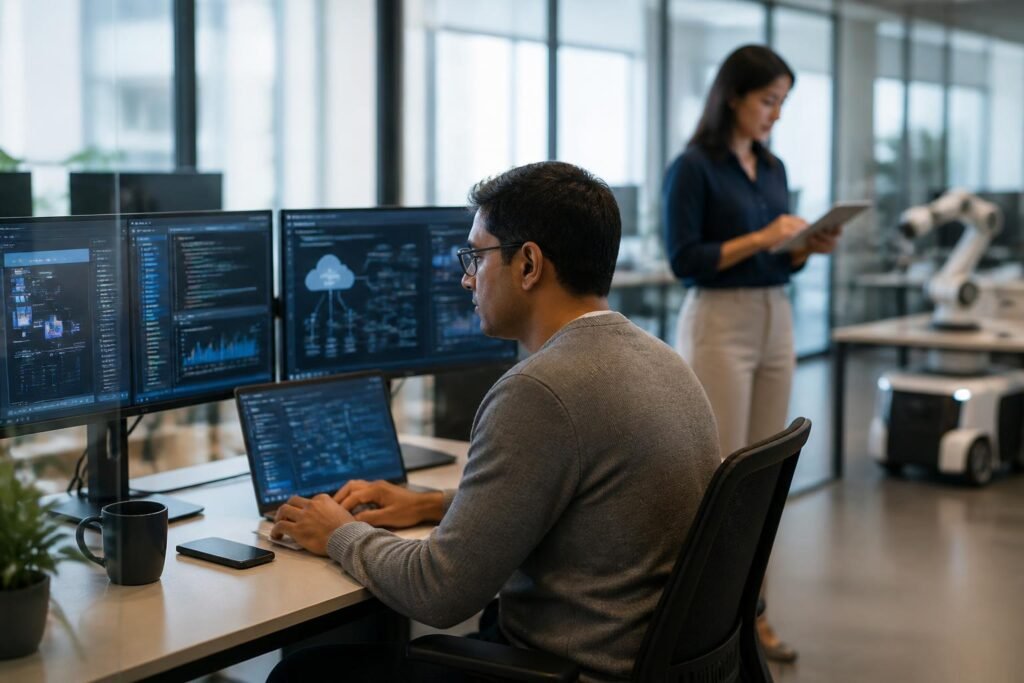
Technology is changing faster than most people can keep up with. Software that once required hours of manual work can now handle parts of the process automatically, while AI is moving from simple chatbots into development tools, business workflows, security systems, and everyday applications.
That makes 2026 an interesting year for anyone searching for tech and software trends, tools, and practical developments.
The biggest change is not simply that software is becoming more powerful. It is becoming more capable of understanding context, taking actions, working with other systems, and assisting people with increasingly complex tasks.
1. AI Is Moving From Chatbots to AI Agents
One of the biggest changes in technology in 2026 is the growing focus on AI agents.
Traditional generative AI usually waits for a person to provide a prompt. An AI agent can go further by planning steps, using connected tools, retrieving information, and carrying out parts of a workflow.
AI agents can help businesses read customer requests, classify questions, search knowledge bases, draft responses, update business systems, and flag unusual requests for human review.
The important distinction is action rather than conversation.
However, automation does not remove the need for human oversight. Businesses still need clear permissions, testing, monitoring, and accountability.
2. AI Is Changing How Software Gets Built
Software development itself is becoming increasingly AI-assisted.
Developers can use AI systems to explain unfamiliar code, generate initial implementations, find bugs, write tests, document projects, and handle repetitive development tasks.
AI does not necessarily replace software developers. Instead, it is changing the development workflow.
A developer might describe the desired behavior, review an AI-generated implementation, test it, identify problems, and refine the result. The human remains responsible for understanding requirements and validating the final software.
Generated code can still contain security vulnerabilities, incorrect assumptions, or inefficient solutions.
For beginners, the practical lesson is simple: learning programming fundamentals remains valuable even when AI can generate code.
Understanding variables, logic, data structures, APIs, databases, testing, and security makes it much easier to judge whether generated code actually works.
3. Cybersecurity Is Becoming an AI Problem
More advanced software creates new opportunities, but it also creates new security challenges.
In 2026, cybersecurity is increasingly connected to artificial intelligence. Organizations must protect not only traditional applications and networks but also AI models, agents, APIs, data, and automated workflows.
AI can help cybersecurity teams strengthen protection, but attackers can also use AI to create more sophisticated threats.
What should everyday users do?
You do not need to become a cybersecurity specialist to improve your digital security.
Start with practical measures:
- Use strong, unique passwords.
- Enable multi-factor authentication where available.
- Keep operating systems and applications updated.
- Be cautious with unexpected links and attachments.
- Review which applications have access to sensitive information.
- Back up important files.
- Avoid giving AI tools unnecessary access to private data.
For businesses, the challenge is broader. AI systems need carefully controlled permissions, logging, monitoring, and clear rules about what information they can access.
The lesson for 2026 is straightforward: more automation should come with more control, not less.
4. Cloud Software Is Becoming More Intelligent
Cloud computing is no longer a new idea. Businesses have been using cloud infrastructure and software-as-a-service platforms for years.
What is changing is the intelligence being built into those systems.
Modern cloud platforms increasingly support AI models, automated workflows, analytics, security monitoring, collaboration, and large-scale data processing.
Instead of installing a separate program on a single computer, a business can use browser-based software connected to cloud services and integrate several applications through APIs.
What does this mean for small businesses?
A small online store, for example, might use:
- A website platform
- Cloud-based email
- Customer management software
- Online payment processing
- Inventory software
- Analytics
- AI-powered customer support
These systems can exchange information automatically.
The advantage is convenience and scalability. The disadvantage is complexity.
When several services depend on each other, businesses need to understand where their data goes, who has access to it, what happens if a provider has an outage, and how difficult it would be to move to another platform.
5. Physical AI and Smarter Devices Are Expanding
Another important direction in tech and software is the movement of AI beyond screens.
AI is increasingly being connected to physical machines, sensors, robots, vehicles, industrial equipment, and other devices.
This is often described as physical AI or embodied AI.
Potential applications include:
- Warehouse robots
- Industrial inspection
- Agricultural equipment
- Autonomous machines
- Smart manufacturing
- Healthcare equipment
- Logistics systems
The underlying software has to deal with a very different environment from a normal web application.
A website can usually retry a failed request. A physical machine operating in the real world has to account for sensors, timing, hardware limitations, safety requirements, and unpredictable conditions.
This is why physical AI is not simply about making larger AI models. It also requires advances in chips, sensors, robotics, connectivity, simulation, and software engineering.
6. Digital Trust and Software Provenance Matter More
As organizations use more third-party software, open-source libraries, AI-generated code, and automatically generated content, knowing where digital assets came from is becoming increasingly important.
This is where digital provenance becomes useful.
Digital provenance helps verify the origin and integrity of software, data, media, and processes.
Why does software origin matter?
Suppose a company uses hundreds of open-source packages inside an application.
If one package contains a vulnerability, the problem may affect the company’s application even though its own developers did not write that component.
Businesses therefore need better visibility into software dependencies and supply chains.
The same principle applies to AI-generated material. As synthetic text, images, audio, and code become easier to create, organizations may increasingly need ways to establish where content came from and whether it has been modified.
For users, this means that trust is becoming a technology feature rather than simply a legal or administrative concern.
When evaluating new software, ask:
- Who develops it?
- How frequently is it updated?
- What information does it collect?
- Does it provide security documentation?
- Can you export your data?
- What happens if the service shuts down?
- Does it clearly explain its AI features?
7. What These Tech and Software Trends Mean for You
Technology trends can sound impressive without being particularly useful.
The more practical question is: What should you actually do with this information?
If you’re a student
Learn how modern software works, experiment with AI responsibly, and build strong fundamentals in programming, data, cybersecurity, and digital literacy.
If you’re a professional
Look for repetitive tasks that can be improved with automation or AI. Start with low-risk workflows and measure whether the technology actually saves time or improves quality.
If you run a small business
Review your current software stack before buying more tools.
You may discover that you are paying for several applications that overlap. Consolidating services can sometimes be more useful than adding another AI product.
If you’re a developer
AI-assisted development is worth understanding, but do not outsource your technical judgment.
Learn how to review generated code, write tests, check dependencies, protect secrets, and identify security problems.
A Simple 2026 Technology Checklist
Before adopting a new tool, ask five questions:
1. What problem does it solve?
If there is no clear problem, you probably do not need it.
2. What data does it require?
Understand what information the software can access.
3. Can a human review important decisions?
For sensitive workflows, human oversight remains important.
4. How secure is it?
Look for updates, authentication controls, security documentation, and responsible data practices.
5. What happens if you stop using it?
Check whether you can export your information and migrate elsewhere.
This approach helps separate genuinely useful technology from short-lived hype.
Frequently Asked Questions About Tech and Software
What is changing in tech and software in 2026?
The biggest changes include AI agents, AI-assisted software development, stronger AI security, physical AI, digital provenance, and increasingly intelligent cloud-based systems.
Are AI agents replacing traditional software?
Not entirely. AI agents are becoming another layer of software that can automate tasks and workflows. Traditional applications, databases, APIs, operating systems, and infrastructure remain essential underneath these systems.
Is AI-generated software safe to use?
AI-generated code can be useful, but it should be reviewed and tested. Developers should check for incorrect logic, security vulnerabilities, exposed credentials, dependency risks, and compatibility problems before putting generated code into production.
What technology skills are useful in 2026?
Useful skills include AI literacy, programming, cybersecurity awareness, data analysis, cloud technologies, automation, communication, and the ability to evaluate AI-generated information critically.
Should everyone start using AI tools?
Not necessarily. The best technology is the one that solves a genuine problem. Before adopting an AI tool, consider its usefulness, cost, privacy implications, security controls, and whether it actually improves your existing workflow.
Conclusion
The technology landscape in 2026 is moving from simple digital tools toward more connected, automated, and intelligent systems.
AI agents are changing how software performs tasks. AI-assisted development is changing how applications are built. Cybersecurity is becoming increasingly important as automation expands, while physical AI is bringing intelligent software into the real world. At the same time, digital provenance and stronger governance are becoming important for maintaining trust.
The important point is not to chase every new trend.
Instead, understand what the technology does, identify the problem it solves, check the risks, and adopt it when there is a clear practical benefit.
The most useful areas to explore further include AI agents, cybersecurity, cloud computing, software development, and automation.