
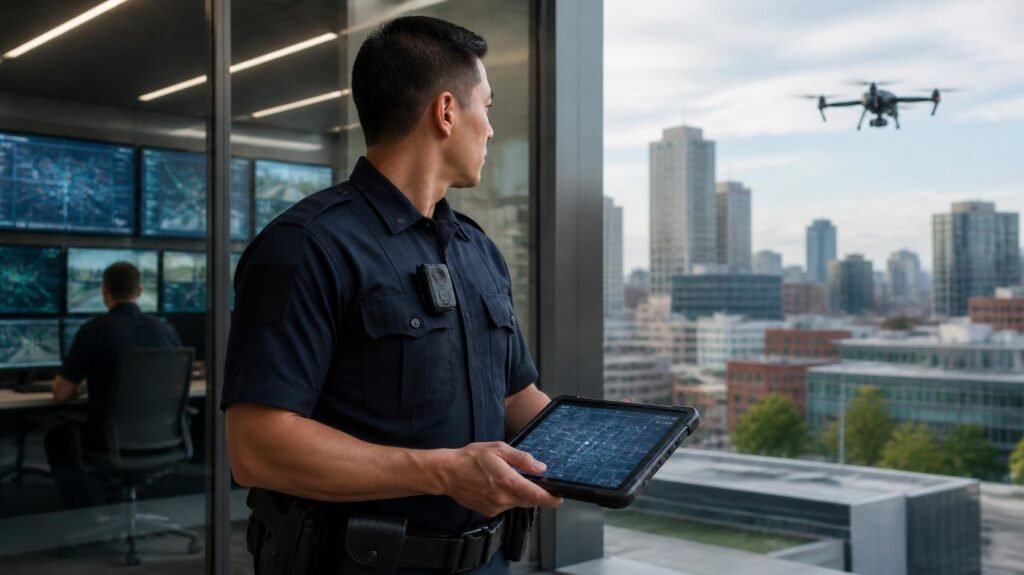
Technology is changing how police officers respond to emergencies, investigate crimes and protect communities. From body cameras and digital evidence to artificial intelligence and drones, modern policing looks very different from how it did a few decades ago.
These developments are often grouped under one idea: policetech, or technology used in policing.
But what does policetech actually involve? Can it make communities safer, and what happens when these systems make mistakes? This guide explains what policetech means, how it works, which technologies matter most, the benefits and risks, and what the future may hold.
Key Takeaways
- Policetech is an informal term for technology that supports police work, from body cameras to AI analysis.
- It helps with evidence handling, emergency coordination and resource planning.
- It also raises real concerns about privacy, bias, cybersecurity and cost.
- Technology should support professional judgement, never replace it.
What Is Policetech?
Policetech is an informal term for the technological tools, software and digital systems used to support police operations, criminal investigations, emergency response and public safety.
The word combines policing and technology. It is not an officially standardised category. In professional settings, you are more likely to see terms such as policing technology, law enforcement technology or smart policing.
Policetech can refer to several types of equipment and digital solutions:
- Body-worn cameras that record interactions between officers and the public.
- Artificial intelligence (AI) systems that analyse large amounts of information.
- Digital forensic tools used to examine electronic evidence.
- Drones that provide aerial views during search operations.
- Communication systems that help emergency responders coordinate.
- Records management software that organises police reports and case information.
These tools perform different functions, but they share one purpose: helping police agencies gather information, manage operations and make better-informed decisions.
How Is Policetech Different From Traditional Policing?
Traditional policing relies heavily on officer observations, witness statements, physical evidence and direct communication. Modern policing still depends on these methods, but technology can support them.
Consider a hit-and-run collision. Officers may interview witnesses and examine physical evidence. Automatic number plate recognition (ANPR), where legally available, might also help identify vehicles matching relevant information.
The technology does not establish guilt. It may provide investigative leads that officers must verify. This distinction matters: technology should support professional judgement rather than replace it.
How Does Policetech Work?
Policetech does not run on one universal platform. It covers many systems built for different police responsibilities. Most follow a similar process: information is collected, processed, reviewed and used to support a decision.
1. Collecting Information
Police technology gathers information through cameras, sensors, communication devices and digital records. An officer’s body camera may capture video during a public interaction, a traffic camera may record vehicle movements, and a digital reporting platform may store incident details.
What is collected depends on the equipment, the operational purpose and the applicable legal requirements.
2. Processing and Analysing Data
Specialised software can then organise the information. Some systems identify patterns, search video recordings, compare records or highlight material investigators need to examine. AI can assist with transcription, document classification and finding relevant material in large datasets.
Automated analysis can produce errors, so human verification remains essential, particularly when findings could affect an individual’s rights.
3. Supporting Police Decisions
Officers then use the reviewed information to decide their next steps. For example, a department could analyse historical emergency call data to find areas with repeated road accidents. That could help authorities plan traffic enforcement or recommend road safety improvements.
Results still need interpretation. A pattern in historical data does not automatically explain why incidents occurred or predict what will happen next.
Key Policetech Technologies Used in Modern Policing
Some of these tools are routine in many police departments, while others remain experimental or controversial. The table below gives a quick overview before the detail.
| Technology | Main use | Key limitation |
|---|---|---|
| AI and data analytics | Analysing reports, video and large datasets | Outputs can be inaccurate or biased |
| Body-worn cameras | Recording officer and public interactions | Depends on policy, activation and oversight |
| Drones | Aerial search, accident reconstruction | Weather, battery life, privacy rules |
| Facial recognition | Generating possible identity matches | A match is not proof of identity |
| Digital evidence management | Storing and tracking evidence | Needs strong security and access controls |
Artificial Intelligence and Data Analytics in Policing
AI is increasingly being explored for administrative work, data analysis and investigative support. It may help agencies process reports, organise evidence or recognise patterns that would be hard to spot manually.
For instance, investigators reviewing hundreds of hours of video could use software to locate segments containing particular objects or activities, reducing the footage that needs initial manual review.
However, AI-generated results are not automatically accurate. Agencies must consider system performance, training data, explainability and the consequences of incorrect outputs.
Body-Worn Cameras
Body-worn cameras are among the most recognisable examples of police technology. These small devices attach to an officer’s uniform and can record audio and video during specific activities.
Recordings may help:
- Document encounters between officers and members of the public.
- Preserve information relevant to investigations.
- Support complaint reviews.
- Improve training and operational assessment.
Body cameras are not a complete answer to police accountability. Their usefulness depends on recording policies, correct activation, access controls, retention periods and independent oversight.
Drones and Aerial Technology
Drones provide aerial images of places that are difficult or dangerous to reach on the ground. Police agencies may use them in missing-person searches, disaster response, accident reconstruction and certain tactical operations.
Imagine emergency teams searching a large woodland area for a missing hiker. A drone with a suitable camera could help them inspect the terrain far more efficiently.
Still, weather, battery life, airspace restrictions and privacy rules can limit drone operations.
Facial Recognition and Biometric Systems
Facial recognition compares facial characteristics in images with information in a reference database. Depending on how it is deployed, it may help investigators generate possible matches or support identity verification.
Other biometric technologies include fingerprints and certain forms of DNA analysis. These differ significantly in scientific method, reliability and legal requirements.
Facial recognition deserves particular caution because a possible match is not proof of identity. Poor image quality, system limitations and demographic differences in performance can all lead to incorrect results.
Digital Evidence Management
Modern investigations involve photographs, recordings, documents, messages and other electronic material. Digital evidence management systems help authorised personnel store, organise, retrieve and share this information.
A well-designed system records who accessed evidence, when, and what they did with it. These logs help maintain the integrity of evidence throughout an investigation.
What Are the Main Benefits of Policetech?
When properly implemented, policetech can improve certain aspects of law enforcement work. Its value depends on whether it solves a real operational problem.
Faster Access to Relevant Information
Digital records let officers retrieve authorised information without searching through large collections of paper files. During an emergency, faster access to accurate information may improve coordination. Outdated records or poorly integrated systems, however, can create confusion instead of efficiency.
Better Emergency Coordination
Communication platforms connect dispatch centres, police units and other emergency services. During a major road accident, coordinated information sharing helps police, firefighters and medical responders understand changing conditions. Reliable communication matters most when several agencies work at the same location.
Improved Evidence Handling
Digital tools help investigators document where evidence came from, how it was stored and who handled it. These processes support the chain of custody, which is important when evidence is presented in legal proceedings.
Technology cannot guarantee that evidence is authentic, but well-designed procedures can reduce avoidable handling mistakes.
More Informed Resource Planning
Data analysis can help departments understand repeated incidents, operational demand and resource gaps. Information about recurring traffic collisions, for example, may help authorities decide where extra road safety measures are worth investigating. Such decisions should also consider local conditions, public feedback and the quality of the underlying data.
Challenges and Risks of Police Technology
Although policetech offers useful capabilities, it also raises serious questions about privacy, fairness, cost and accountability.
Privacy and Surveillance Concerns
Surveillance systems may collect information about people who are not suspected of any crime, including images, vehicle movements, location data or other identifying details. Without safeguards, extensive data collection can interfere with personal privacy.
Police agencies therefore need clear rules on why information is collected, who can access it and how long it is kept.
Algorithmic Bias and Incorrect Results
AI systems learn patterns from data, and those patterns may reflect existing errors or inequalities. A system trained on historical enforcement records, for example, might point to areas with more recorded police activity rather than areas with higher underlying crime.
If these differences are ignored, technology could reinforce unequal enforcement. Independent testing, representative evaluation data and meaningful human oversight are essential safeguards.
Cybersecurity Threats
Police departments hold sensitive information that attracts cybercriminals. A breach could expose personal records, confidential investigations or operational details.
Sensible protections include strong authentication, encryption, restricted access, regular software updates and staff training. Cybersecurity is an ongoing responsibility, not a one-time installation task.
Financial and Training Costs
Buying equipment is only one part of adopting police technology. Departments may also need to pay for:
- Software licences and maintenance.
- Secure data storage.
- Staff training and technical support.
- Independent testing and compliance reviews.
- Equipment replacement and system upgrades.
Smaller agencies may find these ongoing costs especially hard to meet. A system that performs well in a demonstration may prove unsuitable if the agency cannot maintain it properly.
The Future of Policetech: What Comes Next?
The future of policetech will probably involve closer integration between digital evidence systems, communication platforms and AI-assisted analysis. Widespread adoption will depend on technical performance, funding, public acceptance and regulation.
AI-Assisted Administrative Work
One practical use of AI is reducing repetitive administrative tasks, such as drafting summaries, organising documents or transcribing recorded interviews. This could save time, provided outputs are carefully checked and sensitive information is handled securely. Police reports and evidential records still need human responsibility and verification.
Improved Digital Forensics
As more everyday activity involves connected devices, digital evidence is becoming more important. Investigators may need specialised methods to examine mobile devices, cloud records and electronic communications.
Future improvements could make reviewing digital material more efficient, but technical capability must be matched by lawful access, evidence integrity and limits on data collection.
Greater Emphasis on Transparency
Public trust will remain a major consideration. Police departments may face growing expectations to explain which tools they use, why they use them and how mistakes can be challenged.
In the United Kingdom, the College of Policing has published professional guidance covering data-driven technologies and AI-assisted policing. These developments show why governance matters alongside innovation.
Human Oversight Will Remain Essential
Automated systems should not be treated as unquestionable authorities. A system might flag a potential match, highlight an unusual pattern or suggest relevant records, but qualified personnel must still assess the evidence, consider alternative explanations and follow legal standards.
Better technology is only useful when it leads to better decisions.
Frequently Asked Questions About Policetech
What does policetech mean?
Policetech is an informal expression for technology used in law enforcement and public safety. It can include body cameras, artificial intelligence, surveillance equipment, digital forensic tools and communication systems. The word can also appear as a company or brand name.
How is artificial intelligence used in policing?
AI can help police agencies analyse information, transcribe recordings, organise documents and identify patterns in large datasets. Some applications also support investigative searches. Results must be checked because AI systems can produce inaccurate or misleading information.
Can policetech help reduce crime?
Certain technologies may help agencies investigate offences, coordinate responses or spot operational problems. Their impact on crime depends on the specific tool, how it is deployed and the wider policing strategy. Using more technology does not automatically lower crime rates.
Is police technology safe for personal privacy?
Police technology can create privacy risks when it collects, stores or analyses personal information. Clear laws, usage policies, data minimisation, access controls and independent oversight can help reduce those risks.
Will AI replace police officers in the future?
AI may automate selected administrative and analytical tasks, but it cannot reliably replace the full range of human responsibilities in policing. Investigations, public interactions, legal judgement and accountability all require professional oversight.
Conclusion
Policetech reflects the growing role of digital technology in modern law enforcement. From body-worn cameras and digital evidence systems to drones and AI, these tools can help police agencies manage information and improve selected operational processes.
But technology alone does not guarantee safer communities, fairer decisions or more effective investigations. Successful adoption depends on accuracy, clear legal standards, responsible data handling, proper training and public accountability.
For anyone interested in how policing is evolving, understanding both the benefits and the limitations of policetech is the right starting point.
Want to explore further? Read our related guides on artificial intelligence in law enforcement and digital privacy to see how emerging technologies are changing public safety.