
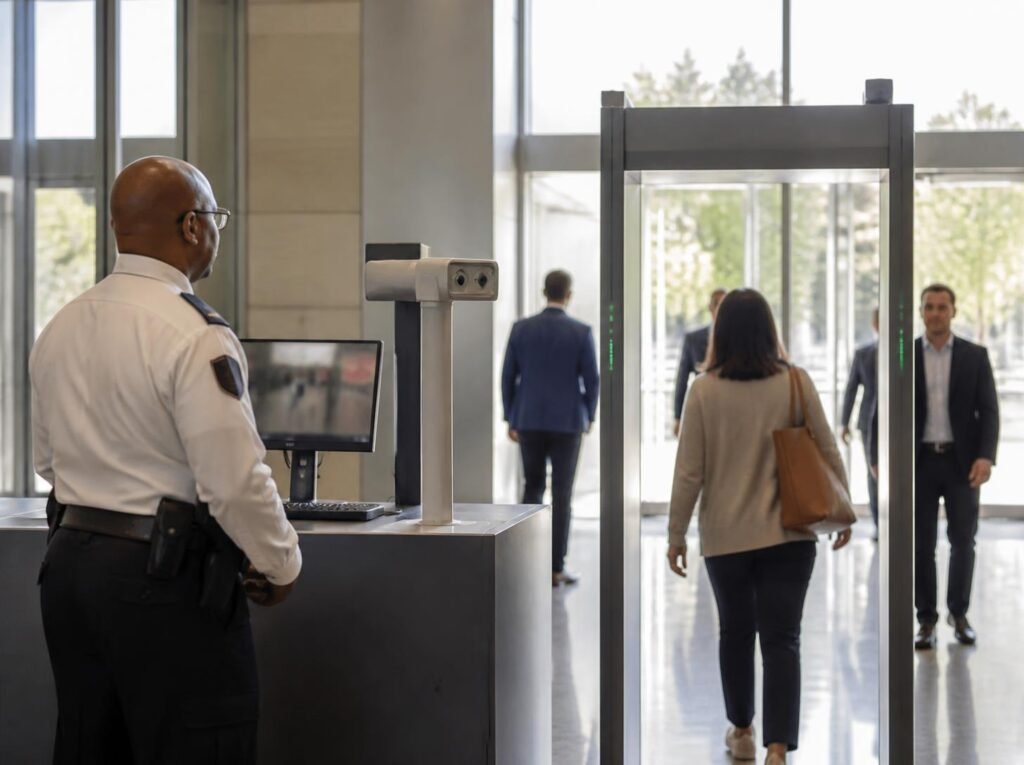
Quick answer: AI-powered weapon detection systems help government buildings identify firearms and other weapons before they pass through entry points, using tools like computer vision, thermal imaging, and metal detection algorithms. These systems work alongside existing security measures—not instead of them—to flag potential threats in real time and alert security personnel faster than traditional screening methods alone.
Walk into any courthouse, city hall, or federal building these days, and you might notice something new tucked beside the metal detectors. It’s not just a scanner anymore. It’s a smart system, quietly watching, learning, and flagging potential threats before a human eye ever could.
Government buildings have always been prime candidates for tight security. They house sensitive records, serve the public daily, and often become symbolic targets. So it makes sense that facility managers and security teams are turning to artificial intelligence to strengthen gun control measures without slowing down the flow of visitors.
This post breaks down what AI-powered weapon detection actually looks like in government buildings, how it works, and what to consider if your organization is exploring this technology. Whether you’re a facilities manager, a policy maker, or just someone curious about the tech shaping public safety, you’ll walk away with a clear picture of where things stand.
What Types of AI Systems Detect Weapons in Government Buildings?
Several categories of AI technology are currently used to identify firearms and other weapons in public facilities:
Computer Vision and Video Analytics
Cameras equipped with AI algorithms scan live video feeds, looking for the visual signature of a firearm. These systems compare shapes, movements, and object outlines against trained models to flag potential weapons. The appeal here is speed. Instead of waiting for someone to walk through a checkpoint, these cameras can spot a visible weapon the moment it enters the frame.
AI-Enhanced Metal Detection
Traditional walk-through metal detectors have been around for decades, but AI is making them smarter. Instead of simply beeping at any metal object, AI-enhanced systems can differentiate between a set of keys, a belt buckle, and an actual firearm. This cuts down on false alarms and reduces the bottleneck at entry points, which matters a lot in high-traffic buildings like courthouses.
Concealed Weapon Detection Systems
Some of the more advanced setups use millimeter-wave or infrared imaging combined with AI to detect concealed weapons under clothing, without requiring a physical pat-down. These systems are designed to flag concerns discreetly, so security staff can intervene without alarming an entire lobby full of visitors.
Predictive and Behavioral Analytics
A newer, more controversial layer involves AI systems that analyze behavioral patterns, like unusual movements or loitering, to flag potential risks before a weapon is even visible. These tools remain experimental and raise valid questions about accuracy and bias, which is worth keeping in mind if your organization is evaluating this category.
Why Are Government Buildings Adopting AI Weapon Detection?
The short answer: speed and consistency. Human screeners get tired, distracted, and overwhelmed during busy hours. AI systems don’t. They can process visual and sensor data continuously, flagging anomalies faster than a person scanning a crowded lobby ever could.
There’s also a staffing angle. Government facilities, especially smaller municipal offices, often don’t have the budget for a large security team. AI tools can supplement a lean staff by doing the first pass of detection, letting human officers focus their attention where it’s actually needed.
And then there’s the deterrence factor. Visible security technology, including AI-driven cameras and scanners, can discourage someone from attempting to bring a weapon into a building in the first place. The goal isn’t just catching a threat. It’s preventing one.
What Are the Limitations and Concerns With AI Gun Detection?
No security system is foolproof, and AI weapon detection comes with its own set of challenges worth understanding before adoption.
False positives and false negatives remain a real issue. Computer vision systems can misidentify everyday objects, like phones or tools, as weapons. Conversely, a cleverly concealed firearm might slip past detection if the system wasn’t trained on that specific scenario.
Privacy concerns are front and center, especially with behavioral analytics and facial recognition components. Civil liberties groups have raised questions about how long footage is stored, who has access to it, and whether these systems disproportionately flag certain groups of people.
Cost and maintenance add up. AI systems require ongoing calibration, software updates, and staff training to use effectively. A government building can’t simply install a system and walk away. It needs a team that understands how to interpret alerts and respond appropriately.
If your building is considering this technology, weigh the trade-off carefully: choose a robust AI detection system if your facility experiences high foot traffic and needs rapid screening, but pair it with trained human oversight if privacy and accuracy are top priorities for your community.
How Can Government Buildings Choose the Right AI Security System?
Picking the right system depends heavily on the building’s specific needs. A small town hall with modest visitor traffic has very different requirements than a federal courthouse processing thousands of people daily.
A few questions worth asking during the selection process:
- How much foot traffic does the building handle daily? Higher traffic usually calls for faster, automated screening like AI-enhanced metal detection.
- What’s the budget for ongoing maintenance, not just installation? AI systems need regular updates and trained staff to stay effective.
- How will the organization handle data privacy? Clear policies on footage retention and access should be in place before any system goes live.
- Does the vendor offer transparency into how the AI model was trained? Understanding the training data helps gauge potential bias or blind spots in detection accuracy.
Taking the time to answer these questions upfront saves a lot of headaches down the road, both for the facility and the people walking through its doors.
Where Is This Technology Headed?
AI-driven security isn’t slowing down anytime soon. As detection algorithms improve and sensor technology becomes more affordable, expect to see these systems appear in smaller municipal buildings, schools, and public service offices that previously couldn’t justify the cost.
The conversation is shifting too. It’s no longer just about whether AI can detect a weapon. It’s about how to do it responsibly, balancing public safety with privacy and fairness. Government agencies exploring this technology would do well to involve community input early, since trust in these systems matters just as much as their technical accuracy.
If you’re part of a team evaluating AI weapon detection for a government facility, start small. Pilot a system in one entry point, gather feedback from staff and visitors, and scale up only once you’ve worked out the kinks. Public safety technology works best when it’s introduced thoughtfully, not rushed.
Frequently Asked Questions
Does AI weapon detection replace human security staff?
No. AI systems are designed to support human security teams, not replace them. They flag potential threats faster, but trained staff still need to verify alerts and respond appropriately.
How accurate are AI gun detection systems?
Accuracy varies by system and vendor. Computer vision and AI-enhanced metal detectors have improved significantly, but false positives and false negatives still occur, which is why human oversight remains essential.
Are there privacy risks with AI security cameras in government buildings?
Yes, particularly with systems that incorporate facial recognition or behavioral analytics. Facilities should establish clear policies on data storage, access, and retention before deploying these tools.
How much does it cost to install AI weapon detection in a government building?
Costs vary widely based on the building’s size, the type of system chosen, and ongoing maintenance needs. Smaller facilities may opt for AI-enhanced metal detectors, while larger buildings might invest in more comprehensive computer vision setups.
Can AI weapon detection systems be fooled?
Like any security technology, AI systems aren’t perfect. Concealed or unusually shaped weapons can sometimes evade detection, which is why layered security approaches, combining AI with trained personnel, remain the most effective strategy.